
web optimization in 2026 is increasing, not altering. Conventional search nonetheless issues, however now web optimization additionally contains AI-driven discovery, social platforms, and chatbots. The rules are the identical, like readability, construction, authority, and relevance, however the platforms are multiplying. We surveyed 59 SEOs to see how they’re dealing with these adjustments.
Some have lower than a 12 months of expertise. Others have been within the discipline for over a decade. Their solutions present an business figuring issues out. Just a few are forward of the curve, however most are nonetheless catching up.
One of the best SEOs aren’t simply reacting to AI. They’re utilizing it to strengthen what already works: technical foundations, high-quality content material, and actual authority. Others are caught debating whether or not web optimization ought to even hold its title.
Right here’s what stood out, and the place Yoast matches into the dialog of what web optimization means in 2026.
You’ll find the complete outcomes, with extra questions and deeper insights from Yoast’s principal SEOs, Carolyn Shelby and Alex Moss, in a downloadable PDF. Enroll beneath!
Obtain the PDF report now
Enter your e mail tackle beneath. We’ll ship you a obtain hyperlink to the complete Yoast Perspective PDF report. Examine your inbox, because it’ll arrive in minutes.
1. web optimization isn’t dying, however evolving
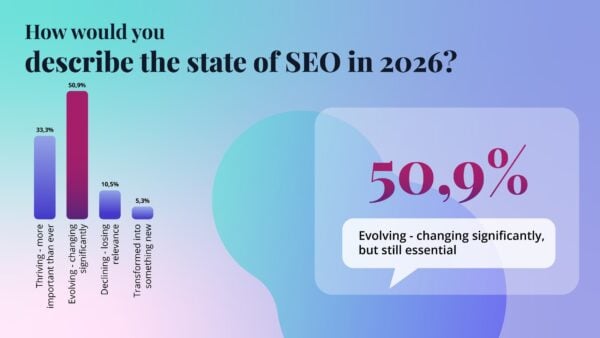
51% of respondents take into account web optimization to be “evolving”. 33% say it’s “thriving”. Solely 10% assume it’s “declining”.
That is an fascinating divide, however it’s not random. Within the outcomes, these with 10+ years of expertise say web optimization is flourishing, whereas newcomers say it isn’t. It could be that specialists know the panorama higher and see change as a fixed.
Alex Moss’s take: “web optimization has at all times tailored to adjustments within the SERP, and now it’s adapting once more. The standard SERP is gone, however web optimization isn’t.”
Carolyn Shelby’s take: “web optimization is evolving, however not as a result of its fundamentals are breaking. The interfaces between customers and knowledge are altering. Search is not confined to 10 blue hyperlinks, however the want for structured, related, reliable content material hasn’t diminished.”
The Yoast Perspective: We expect web optimization isn’t going wherever, however there are adjustments taking place. Conventional search from Google and Bing nonetheless drives site visitors, however AI-driven discovery from LLM-powered assistants shapes notion and discovery. Due to this fact, one of the best SEOs don’t select sides on this battle; they’re mastering each instructions.
2. Hold the title Search Engine Optimization
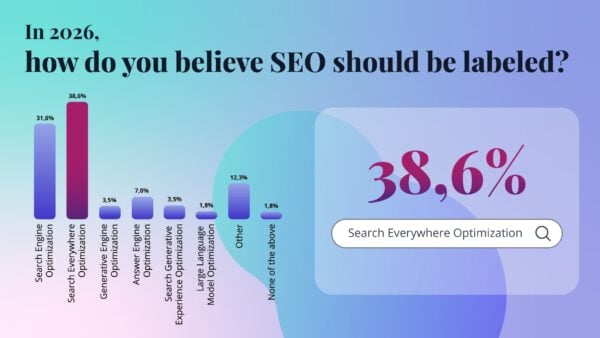
39% say web optimization ought to be relabeled “Search In all places Optimization”. Solely 32% need to hold “Search Engine Optimization”.
Large assist for relabeling web optimization, and even amongst veterans, 41% desire Search In all places Optimization. After all, this doesn’t imply that we must always do that.
Alex Moss’s take: “The time period ‘web optimization’ will keep. The function will widen to incorporate AI and different disciplines, however the title doesn’t want to alter.”
Carolyn Shelby’s take: “The time period ‘web optimization’ nonetheless holds shared which means, credibility, and market recognition. There’s no robust proof that rebranding the self-discipline itself is important or helpful. Responses favoring ‘Search In all places Optimization’ mirror the place web optimization outcomes now floor, not a essentially completely different apply.”
The Yoast Perspective: We at Yoast don’t assume the time period web optimization is damaged. Sure, there’s a whole lot of change taking place, particularly in search, with AI overviews, chatbots, and social media platforms, however what in regards to the core web optimization work? You continue to should deal with technical foundations, content material high quality, model constructing, and authority.
‘Search In all places Optimization’ would possibly describe the place web optimization occurs, however it doesn’t change what web optimization is. The title ‘web optimization’ nonetheless works, however we simply want to elucidate the way it applies to AI and social platforms.
3. Good web optimization is LLM optimization
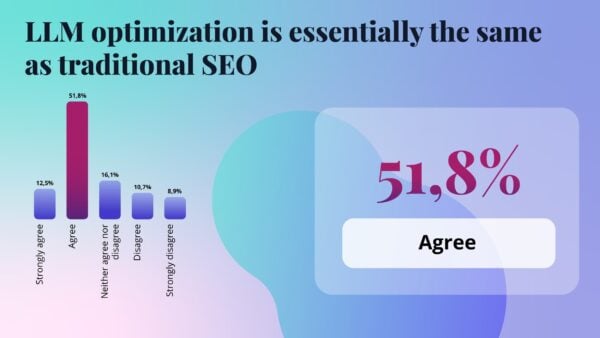
64% agree LLM optimization is primarily the similar as conventional web optimization. 59% aren’t even actively optimizing for LLMs.
You would possibly name this laziness, however you might additionally name it effectivity. It oftentimes comes right down to the identical factor.
There’s additionally the 9% who strongly disagree with this assertion. These respondents say LLMs prioritize synthesis over rankings, so specializing in structured knowledge and model mentions makes extra sense for them. After all, they aren’t unsuitable, however they don’t contradict what others have stated. LLMs don’t require new ways; they only reward the identical web optimization rules extra strictly.
Alex Moss’s take: “If you’re endeavor good web optimization, you’re already optimizing effectively for LLMs. The ways don’t change—simply the viewers.”
Carolyn Shelby’s take: “The identical practices that make content material discoverable and reliable for search engines like google and yahoo additionally make it usable for LLMs. The confusion arises when individuals deal with LLMs as a very separate system. In actuality, LLM visibility rewards readability, relevance, and authority—all long-standing web optimization rules.”
LLM optimization isn’t a separate self-discipline as a result of it’s web optimization for AI. The identical rules apply: readability, construction, and authority. The distinction? AI programs are much less forgiving of mediocre content material, so the bar for high quality is larger.
4. Rankings nonetheless matter, however not like they used to
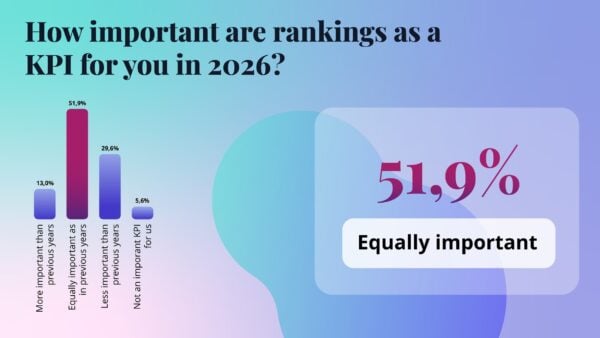
52% say rankings are “equally vital” as earlier than. 30% say they’re “much less vital”.
This can be a wise shift. Google’s AI overviews and different zero-click outcomes imply visibility doesn’t equal site visitors. For AI programs, rankings are nonetheless an authority sign.
Alex Moss’s take: “Conventional rankings are nonetheless vital as a result of brokers nonetheless search the online to ingest data. When you aren’t seen there, it’s much less doubtless an agent will establish and choose you into their responses.”
Carolyn Shelby’s take: “Rankings nonetheless matter, however they’re not the top objective. They’re a proxy for visibility, not a assure of influence.”
The Yoast Perspective: We have to cease obsessing over rating primary, so begin monitoring visibility and presence. Examine whether or not you might be cited in AI-driven solutions, and attempt to be talked about in business discussions. AI visibility and citations are the brand new rankings.
5. Natural site visitors remains to be king, however for the way lengthy?
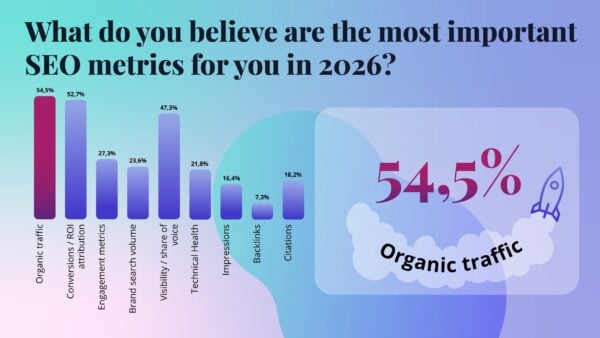
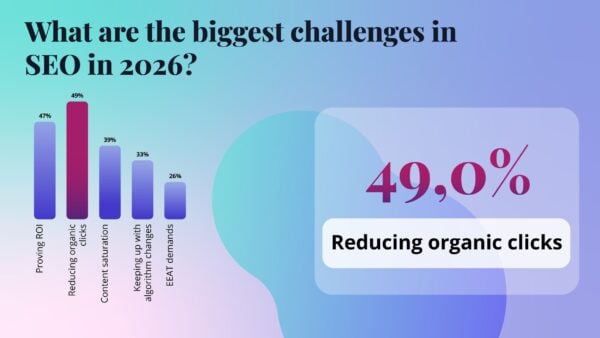
55% say “natural site visitors” is their prime metric. But 49% cite “lowering natural clicks” as their greatest problem.
We see this as the good paradox of 2026. Site visitors is down, however the worth of that site visitors could possibly be up. You would possibly get much less site visitors, however the clicks that do occur have a greater intent.
Carolyn Shelby’s take: “As AI reduces the necessity for some visits, success seems to be like being represented appropriately fairly than merely visited. Visibility in AI overviews doesn’t at all times drive clicks, however it builds legitimacy. Being included indicators that you just’re a reputable supply, even when customers don’t click on.”
Our recommendation:
- Work on AI visibility, as that is the brand new web optimization metric. Simply as rankings present your visibility in conventional search, citations in AI overviews present your authority in AI-driven discovery. Monitor it alongside rankings and site visitors
- Regulate branded search quantity to study whether or not persons are on the lookout for you by title
- Monitor citations to see if others are referencing your content material on-line
6. Content material saturation is an enormous risk
39% say “competing with AI-generated content material” is their prime problem. Solely 4% cite a “expertise hole.”
We all know AI can write unhealthy content material. However it’s an even bigger problem when AI writes adequate content material at scale. This may flood the online with noise, making it onerous to penetrate.
Alex Moss’s take: “AI-generated content material is synthetic. People join with tales, not regurgitated lists.”
Carolyn Shelby’s take: “AI doesn’t change what good content material is, however simply raises the bar. Mediocrity doesn’t simply rank decrease; it disappears.”
Our recommendation:
- Concentrate on constructing your EEAT, as a result of AI can’t pretend real-world experience and authority
- Prioritize high quality over amount, as a single nice piece of content material can beat ten common ones
- Use AI, however watch out and at all times use it as a software, not as a substitute
7. Most SEOs are ignoring a fast-growing search channel
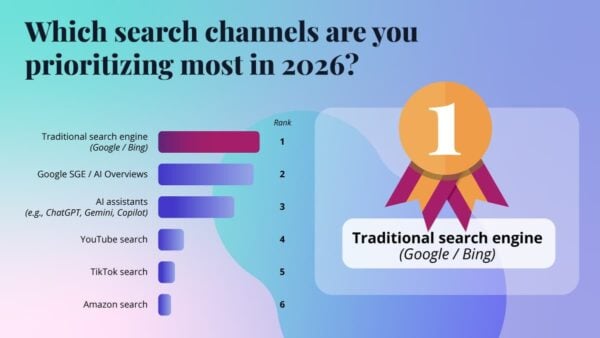
Conventional search (Google/Bing) remains to be #1. However TikTok search ranks #5, decrease than Amazon.
This could be one thing of a blind spot for a lot of. Youthful generations use TikTok and different video platforms for leisure, suggestions, tutorials, and even B2B recommendation.
Alex Moss’s take: “Social platforms affect how LLMs understand freshness and authority. Ignoring them means lacking out on indicators that AI programs worth.”
Carolyn Shelby’s take: “You don’t must rank on TikTok, however you do have to be discoverable there. LLMs scrape social platforms for real-world indicators.”
The Yoast Perspective: web optimization now contains social platforms like TikTok. You don’t must rank there, however you do have to be discoverable, as a result of LLMs scrape these platforms for recent, authoritative content material. An incredible video channel can enhance your authority in AI responses.
Our recommendation:
- Repurpose content material for video platforms like TikTok and YouTube
- Examine model mentions in these platforms
- Enhance your video web optimization basically
What Yoast’s specialists actually assume
The info exhibits developments, however the true knowledge comes from Yoast’s web optimization leaders, Carolyn Shelby and Alex Moss. Here’s a small peek on the insights they share in regards to the numerous debates:
On “Search In all places Optimization”:
Alex: “The time period ‘web optimization’ will keep. The function will widen, however the title doesn’t want to alter.”
Carolyn: “Rebranding dangers fragmenting understanding. ‘web optimization’ is already well-established outdoors the business.”
On the way forward for web optimization metrics:
Alex: “As we transfer from being seen to being chosen, visits don’t maintain the identical worth they used to. The enterprise objective ought to be an important metric.”
Carolyn: “Visibility in AI overviews doesn’t at all times drive clicks, however it builds legitimacy. Being included indicators that you’re a reputable supply.”
On rankings vs. affect:
Alex: “Rankings nonetheless matter as a result of brokers search the online to ingest data.”
Carolyn: “Rankings are a proxy for visibility, not a assure of influence. Concentrate on presence.”
On the function of SEOs in 2026:
Alex: “100% all three: entrepreneurs, model builders, and web optimization specialists. Model and advertising have grow to be intertwined with web optimization as our function expands.”
Carolyn: “A blended mindset is important. web optimization can’t function in isolation from model, product, or communications.”
Do you need to learn the complete story?
These insights are only a small taster for you. Within the full Yoast web optimization report, you’ll discover far more:
- Consists of the full solutions to all 25 questions
- In-depth commentary from Yoast’s web optimization specialists, Carolyn Shelby and Alex Moss
- Be taught which metrics actually matter in 2026
- Why backlinks are dropping floor to citations
Sign up and download it right away!

